

There’s More to the Okanagan Than What’s in the Glass
The Okanagan is wine country.
It is also grassland country, orchard country, ranching country, lake country, forest country—and home.
Vineyards have become an important part of the Okanagan landscape and of British Columbia’s agricultural and tourism economy. As of June 2026, B.C. has 1,234 vineyards covering more than 12,681 acres (5,132 hectares) of planted land, along with 277 licensed grape-wine wineries. B.C. wineries welcome more than 1.19 million visitors each year, and Wine Growers British Columbia reports an annual economic contribution of approximately $3.75 billion. (Wines of British Columbia)
Those numbers tell only part of the story.
A winery can be a farm, a workplace, a processing facility, a restaurant and a tourism destination all at once. Wine tourism connects vineyards to accommodations, restaurants, transportation, retail and other local businesses. For many people, visiting a vineyard has become part of how they experience the Okanagan.
But vineyards are also part of an ecological system with limits.
The Okanagan is semi-arid. Water is precious. Some of its grasslands and shrub-steppe ecosystems are among the rarest in Canada. Agriculture, roads, housing, and other development have fragmented wildlife habitat. Climate change is bringing new pressures through drought, extreme temperatures, wildfire and unpredictable weather.
So what does it mean to grow grapes here?
Rather than asking whether vineyards are good or bad for the environment, there may be a more useful question:
What can agriculture give back to the landscape that supports it?
The land wasn’t empty before the vines
The Okanagan’s agricultural landscape did not begin with vineyards.
People have long tended this valley and its plants, harvested food and medicines, travelled through it, and managed landscapes in ways that continue today. More recently, agriculture has become a major part of the regional economy, with orchards, vineyards, livestock and other crops occupying land throughout the valley.
But agricultural land is still ecological land.
That matters here because some of the places best suited to grape growing are also among the most ecologically significant.
The valley’s warm, dry benches and slopes support grasslands and shrub-steppe communities adapted to intense summer heat and limited precipitation. Antelope-brush ecosystems, for example, occur primarily in the hottest and driest parts of the South Okanagan.
They are also exceptionally rare.
A federal assessment of the Okanagan Efferia, a rare robber fly associated with antelope-brush ecosystems, estimated that about 67% of the Antelope-brush/Needle-and-thread grass habitat had been destroyed by agricultural, housing and other development following European settlement. In 2008, only 7.1% of the remaining habitat assessed was considered to be in good or excellent condition. (Canada)
Vineyards are directly connected.
Federal assessments identify vineyard development as a major threat to low-elevation antelope-brush habitat, in part because the gravelly, well-drained soils of these ecosystems can also be excellent for grape production. (Canada)
That doesn’t mean every vineyard was established on intact grassland. Some vineyards replaced existing agricultural land, including orchards. Historical assessments have documented both patterns.
It does mean that where agriculture happens matters.
By the numbers
1,234
B.C. vineyards12,681+ acres
of planted wine grapes277
licensed grape-wine wineries1.19 million+
annual winery visitors$3.75 billion
reported annual contribution of B.C.’s wine industry to the provincial economy (Wines of British Columbia)
The first environmental decision may happen before the vines are planted
We often talk about vineyard sustainability in terms of what happens after the vines are in the ground:
How much water is used?
What grows between the rows?
Which pesticides are used?
How is soil managed?
But from an ecological perspective, one of the most consequential decisions may happen much earlier:
What was here before the vineyard?
Replacing an existing orchard with grapes is not ecologically equivalent to clearing intact native grassland.
Both change the land. But they begin with very different ecological conditions.
An intact grassland contains native plants, soil organisms, insects and wildlife relationships that can take generations to develop. Once those soils and communities are cleared and cultivated, planting vegetation somewhere else does not simply recreate what was lost.
This is why habitat protection and vineyard management are two different, though connected, conversations.
Good management within an existing vineyard can reduce some environmental pressures.
It cannot recreate an intact grassland that has already been cleared.
Water: growing grapes in a dry valley
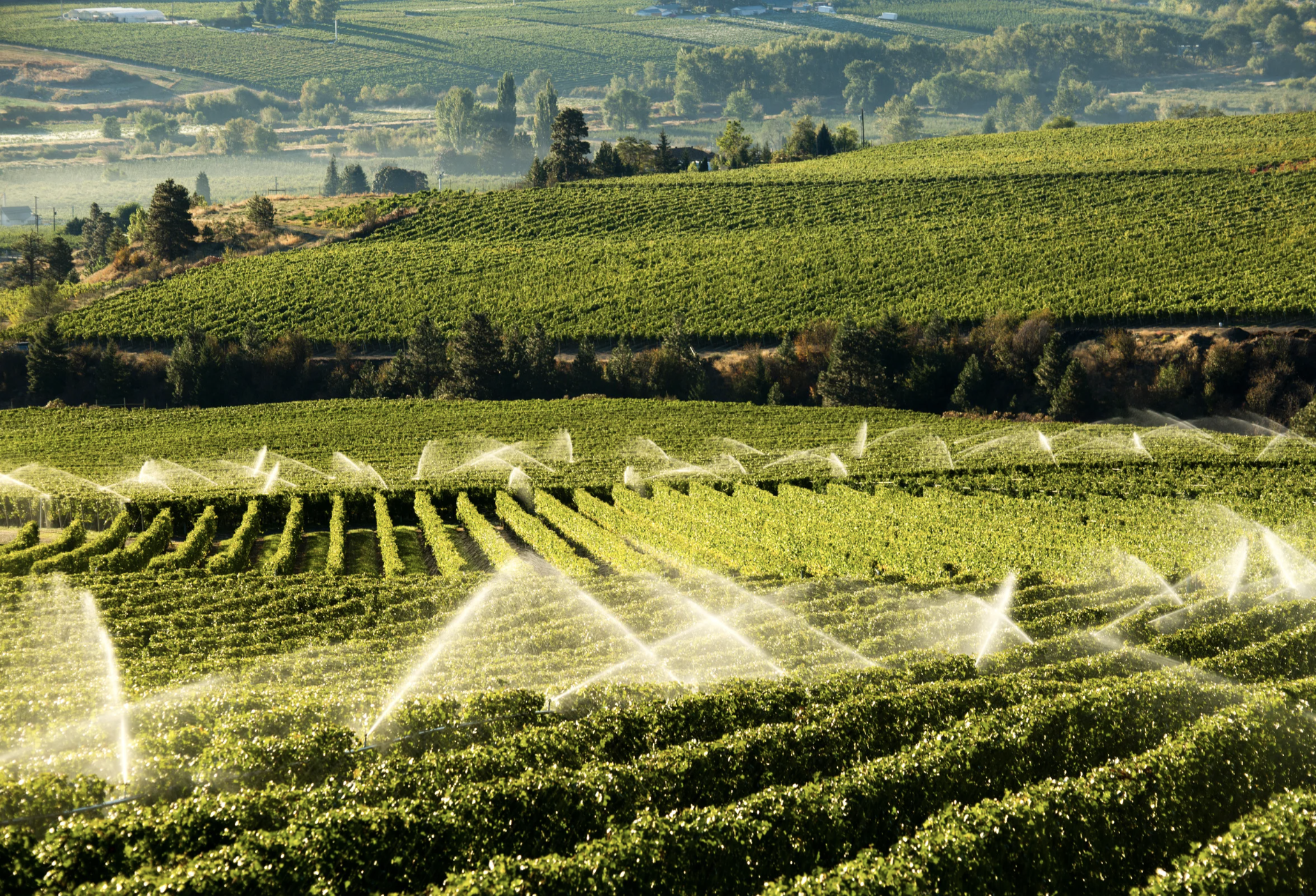
The Okanagan is one of Canada’s driest agricultural regions, and commercial grape production depends on irrigation.
That makes water efficiency an obvious area of interest—and a complicated one.
B.C. researchers have been working with growers to understand irrigation technology, water tracking and the actual costs of water use in vineyards. One provincial project developed tools to help growers measure water use and compare it across vineyards and growing conditions. (BC Climate Change Adaptation Program)
Another project took a more precise approach.
Researchers mapped soil characteristics within vineyards and installed irrigation equipment designed to deliver water and nutrients according to differences in soil conditions. Over two years, the project improved understanding of soil structure, water-holding capacity and vine growth. The upgraded system also reduced the labour required for irrigation management.
But here’s the important part:
The study did not demonstrate a reduction in total water use during the two-year project.
The researchers noted that the vines had not had enough time to fully adapt to the new irrigation system. (BC Climate Change Adaptation Program)
That is actually a useful result.
Environmental technology isn’t automatically an environmental outcome.
If we want to know whether a practice saves water, we have to measure the water.
And water stewardship extends beyond irrigation equipment. Wetlands, streams, riparian vegetation and natural areas all play roles in storing, filtering and moving water through a watershed. Protecting those systems is part of protecting the water resources agriculture depends upon.
Soil is a living community
Look between rows of vines and you might see bare earth, grasses, flowering plants or some combination of the three.
Underneath, something much more complicated is happening.
Soil contains fungi, microorganisms, roots, insects and other invertebrates. Organic matter feeds soil life and contributes to nutrient cycling and water-holding capacity.
That makes soil management one of the most interesting places to explore the relationship between agriculture and ecology.
Cover crops
B.C. researchers and growers are experimenting with plants grown between vineyard rows and beneath vines.
One recent project tested 23 cover-crop species in irrigated vineyards. Legumes such as white clovers generally produced the most biomass and contributed the most carbon and nitrogen to the soil. Other species may be useful where water or nutrients are more limited because they demand less of those resources. (British Columbia Wine Grape Council)
Other research has spent six years investigating cover crops specifically for Okanagan vineyards, with the goal of developing a decision-making tool that helps growers choose species based on their goals, local conditions, and management practices. (British Columbia Wine Grape Council)
There isn’t one universally “best” cover crop.
In a dry valley, plants growing between vines can also compete with grapevines for water and nutrients.
So the interesting question isn’t simply:
Should vineyards have cover crops?
It’s:
Which plants work, where, when and for what purpose?
When biodiversity becomes part of pest management
Soil and groundcover aren’t only about erosion and nutrients.
They can also influence the organisms that live in and around vineyards.
Research in the Okanagan has investigated whether certain cover crops can help manage soil-borne grapevine pests. In one study, shepherd’s purse and white mustard showed potential to reduce parasitic nematode populations; researchers estimated that the presence of those plants was associated with a 46% and 52% lower likelihood of finding parasitic nematodes, respectively. (British Columbia Wine Grape Council)
Other research has looked at the relationship between groundcover diversity and insect pests.
A multi-year project examined 98 large vineyard study blocks, investigating relationships among vegetation, soils and cutworm damage to grapevine buds. The researchers also considered factors such as pesticides and irrigation. (British Columbia Wine Grape Council)
These studies don’t mean that biodiversity eliminates pests.
They point to something more interesting:
Ecological relationships can sometimes become part of the agricultural toolbox.
Pesticides: working with an ecosystem
Vineyards face insects, mites, fungal diseases, weeds and other pests. Managing those problems is part of producing a crop.
The question is how.
Integrated Pest Management, or IPM, combines monitoring and prevention with cultural, biological, physical and chemical controls. Rather than automatically treating a pest when it appears, IPM considers factors such as the species involved, its abundance, potential damage, natural enemies and the likely effects of different control options.
This doesn’t mean “no pesticides.”
It means using them more deliberately—and considering what other tools might reduce the need for them.
B.C.’s grape-production guidance includes monitoring and pesticide-resistance management, while Sustainable Winegrowing BC provides vineyard tools for integrated pest-management monitoring, pesticide records and nutrient management. (Sustainable Winegrowing BC)
Local examples also include growers experimenting with habitat as part of this approach.
Birds as vineyard neighbours
Okanagan Similkameen Stewardship’s Wildlife Habitat Stewardship program includes more than a dozen wineries and vineyards in the Okanagan and Similkameen.
The participating properties use different approaches. Some retain large areas of natural habitat. Others restore native vegetation or install bird boxes and raptor poles. (osstewardship)
OSS identifies Tantalus Winery, Ghost Pine Vines and Heidi’s Peak Estate Vineyard as examples where bird boxes and raptor roosting poles have been used. At Heidi’s Peak, owner Heidi Lorch reported that Western Bluebirds and Tree Swallows help reduce leafhopper populations in the vineyard. That’s an individual grower’s observation rather than a controlled experiment, but it illustrates the broader concept: wildlife can be part of an agricultural system rather than simply something outside it. (osstewardship)
The goal isn’t to replace every other pest-management method with birds.
It’s to recognize that a vineyard is already part of a food web.
Biodiversity in the vineyard
In August 2025, researchers and growers held two Biodiversity in the Vineyard field tours in the Okanagan.
The southern tour visited Thomas Ranch Vineyard in Okanagan Falls and Diamondback Vineyard in Oliver, where participants explored cover crops, soil health, beneficial insects, nematodes, native plants and equipment for managing groundcover. (British Columbia Wine Grape Council)
The northern tour visited Waldhof Vineyards in Kelowna and Kalala Vineyards in West Kelowna, with demonstrations focused on cover crops, soil health, beneficial insects, nematodes and field-based soil testing. (British Columbia Wine Grape Council)
These weren’t showcase tours declaring the vineyards environmentally perfect.
They were research and demonstration sites.
And that distinction matters.
Active vineyards are becoming places where researchers can investigate whether ecological processes can become part of agricultural management.
But a biodiverse vineyard is not a grassland
This distinction is important enough to say plainly.
A vineyard with diverse groundcover can support more ecological relationships than a vineyard with bare soil.
That does not make it equivalent to native grassland.
An intact grassland contains a complex community shaped by its soils, climate, native plants, fungi, insects and wildlife. Some of those relationships may take centuries to develop.
Once native habitat has been cleared, planting a few native species elsewhere doesn’t recreate the original ecosystem.
So these approaches are complementary:
Protect what remains.
Restore where we can.
Increase biodiversity within working landscapes.
The habitat beyond the vines
Some of the most important ecological decisions on a farm happen outside the cultivated rows.
A creek.
A wetland.
A grassland slope.
A patch of native shrub-steppe.
A strip of riparian vegetation.
A natural edge between farm and forest.
These places can provide habitat, protect water and give wildlife somewhere to move through an increasingly fragmented landscape.
Okanagan Similkameen Stewardship’s Wildlife Habitat Stewardship program works with landowners to conserve and enhance wildlife habitat while continuing agricultural and other land uses. (osstewardship)
*And there are some fascinating vineyard examples:
Forbidden Fruit & Synchromesh: leaving habitat intact
OSS reports that Forbidden Fruit Winery and Synchromesh Wines each retain more than 60 acres of natural habitat on their properties.
At Forbidden Fruit, the retained habitat is important for wildlife including Western Screech-owls and Yellow-breasted Chats. At Synchromesh, OSS identifies habitat used by species including Bighorn Sheep and Pallid Bats. (osstewardship)
Sometimes the most important conservation action is not restoration.
It’s not clearing something in the first place.
Mt. Boucherie & Okanagan Crush Pad: restoration
Other properties have taken a more active approach.
Okanagan Similkameen Stewardship identifies Mt. Boucherie Estate Winery and Okanagan Crush Pad Winery as examples of vineyards where large-scale habitat restoration projects have taken place. (osstewardship)
Okanagan Crush Pad also publicly documents a number of stewardship projects at its properties, including restoring grazing fields along Eneas Creek to natural habitat, preserving a stream and wildlife gully, creating wildlife corridors and rehabilitating former dump sites. (Okanagan Crush Pad)
Restoration can bring back native vegetation and reconnect ecological processes.
But restoration is not a substitute for protection.
A restored area may take years to develop, and it does not necessarily recreate all of the ecological complexity of an intact ecosystem.
Summerhill: making space for habitat
The Stewardship Centre for BC has profiled Summerhill Pyramid Winery as an agricultural stewardship case study.
The property has set aside more than 25% of its land for wildlife use, including riparian areas, springs, a year-round creek and wetland. The case study also highlights composting, agroforestry, bird and bat boxes and pollinator habitat. (Stewardship Centre for BC)
This is a useful example of a larger idea:
A farm does not have to be productive everywhere in order to be productive overall.
Natural areas can remain part of an agricultural property while the farm continues to grow crops and contribute to the local economy.
Tantalus: what’s left after the grapes?
Ecological stewardship doesn’t stop at the vineyard.
Winemaking generates wastewater and organic material, and dealing with those materials can create another set of environmental pressures.
At Tantalus Vineyards in Kelowna, a winery wastewater system treats process wastewater and domestic sewage using anaerobic treatment, settling, aeration, pH adjustment, UV disinfection and filtration. A B.C. Wine Grape Council case study reports that the treated effluent is suitable for irrigation and that the system has a relatively small footprint, while also noting its high initial capital cost and maintenance requirements. (British Columbia Wine Grape Council)
Tantalus itself reports that its wastewater treatment system processes 100% of its winery effluent and domestic sewage and describes the winery and vineyard as Sustainable Winegrowing BC certified since 2021. (Tantalus Vineyards)
This is another reminder that sustainability isn’t only about what happens to a grape while it’s growing.
It’s also about what happens to everything that comes after it.
From waste back to soil
Grape skins, seeds and stems are generated during winemaking, while vineyards produce prunings and other plant material.
Some B.C. projects have explored whether these materials can return to the soil.
A documented project involving Lastella Winery, Enotecca and Le Vieux Pin experimented with composting grape skins and stems with woody material from a nearby sawmill and returning the compost to vineyard soils.
The idea is simple:
Instead of asking only “How do we dispose of this?”, ask:
“What nutrients and organic matter are we losing from the system—and can we cycle some of them back?”
That won’t always be the right answer. Composting requires space, equipment, labour and appropriate management.
But it is one example of moving from a linear model of production toward a more circular one.
A vineyard is part of a bigger landscape
Wildlife don’t recognize property boundaries.
A bat moving between feeding and roosting habitat doesn’t know where a vineyard ends. A snake moving between seasonal habitats encounters fences and roads, not legal parcels. Birds need places to feed, nest and move through the landscape.
This is why landscape-scale conservation matters.
A vineyard can be carefully managed internally while surrounding natural areas continue to disappear.
Conversely, a vineyard surrounded by connected grasslands, forests, wetlands and riparian areas can contribute to a much larger ecological network.
Natural areas retained on agricultural properties can act as stepping stones between larger habitats. Riparian strips can connect waterways. Grassland patches can maintain movement routes for wildlife.
In a valley already experiencing fragmentation, connectivity can be as important as any individual habitat patch.
The economics matter
It would be easy to write this story as though ecological protection is simply a matter of making different choices.
Real farms are more complicated.
Growers manage frost, drought, pests, disease, labour, markets, wildfire, and increasingly unpredictable weather.
Recent years have made that particularly clear for B.C.’s wine industry. Extreme cold events in 2022–23 and 2023–24 caused widespread vineyard damage and major economic losses.
The vulnerability is partly inherent in perennial agriculture: vines are investments that take years to establish, and an extreme weather event can affect production far beyond a single growing season.
That makes resilience an important meeting point between agriculture and ecology.
Healthy soil can help with water retention.
Natural vegetation can reduce erosion.
Efficient irrigation can reduce unnecessary water use.
Integrated pest management can help reduce pesticide reliance and resistance.
Riparian areas can protect waterways.
Habitat can support pollinators and natural pest control.
And natural areas can continue providing ecological functions as the climate changes.
Not every ecological practice will save money.
Not every environmentally beneficial decision is inexpensive.
And sometimes there are genuine trade-offs.
A useful conversation about agricultural sustainability should be honest about them.
What does “sustainable” actually mean?
B.C.’s wine industry has developed its own voluntary sustainability certification program: Sustainable Winegrowing BC.
The program was created specifically for B.C.’s wine sector and covers vineyard and winery practices related to soil, water, biodiversity, pest management, waste, worker well-being, and other environmental and business considerations. The program describes its certification as outcomes- and improvement-based, with third-party audits. (Sustainable Winegrowing BC)
Its resources include tools for integrated pest-management monitoring, pesticide records, waste tracking and nutrient management. (Sustainable Winegrowing BC)
That’s an important development.
But even a sustainability certification can’t answer every ecological question.
A vineyard can improve its soil management while the landscape around it continues to lose habitat.
A vineyard can retain natural habitat while still using substantial irrigation.
A farm can reduce pesticide use while facing difficult pest pressures.
There is no single number that captures the ecological health of a vineyard—or its relationship with the landscape around it.
So what can a vineyard give back?
Maybe it’s water.
Using only what the vines need. Measuring what is actually being used. Protecting the wetlands and waterways that sustain the watershed.
Maybe it’s soil.
Keeping it covered. Feeding the organisms within it. Reducing unnecessary disturbance. Returning organic matter where appropriate.
Maybe it’s biodiversity.
Making room for native plants, beneficial insects, birds and bats.
Maybe it’s habitat.
Leaving a grassland slope intact. Protecting a wetland. Restoring a riparian area.
Maybe it’s connectivity.
Keeping natural spaces connected across a landscape divided by roads, fences and development.
Maybe it’s a different approach to waste.
Treating wastewater. Composting grape material. Keeping nutrients cycling through the farm.
And sometimes, the most important thing a vineyard can give back is simply the habitat it chooses not to remove.
There is no perfect vineyard
This may be the most important part of the conversation.
The word sustainable can make a complicated question sound like a checklist.
And there simply isn’t one.
A vineyard might have excellent soil management but occupy land where native grassland was cleared.
Another might retain extensive natural habitat yet face challenges with irrigation.
Another might be experimenting with cover crops, composting or integrated pest management while still trying to determine which practices produce measurable benefits.
And growers are making these decisions within a business that needs to survive.
So rather than asking:
Which winery is the most sustainable?
we think there are better questions:
What practices are being tried?
What evidence supports them?
What are the trade-offs?
What was here before the vineyard?
What remains around it?
And what does this particular place need?
A living Okanagan
The future of the Okanagan won’t be shaped by vineyards alone.
Decisions about agriculture, housing, water, tourism, transportation, wildfire, conservation, climate adaptation, and the remaining natural spaces between them will shape it.
The goal isn’t to choose between agriculture and nature.
It’s to find ways for working farms, grasslands, wildlife and people to share a healthy Okanagan landscape.
Vineyards are part of this landscape.
So are the grasslands on the other side of the fence.
So are the orchards, wetlands, forests, lakes, rivers and communities that surround them.
The land supports agriculture.
What can agriculture give back?
Further reading & resources
Sustainable Winegrowing BC
B.C.’s voluntary vineyard and winery sustainability certification program, with standards and practical tools covering soil, water, biodiversity, pest management, waste and more. (Sustainable Winegrowing BC)
B.C. Wine Grape Council
Research and field demonstrations exploring cover crops, soil health, irrigation, pests and biodiversity in B.C. vineyards. (British Columbia Wine Grape Council)
B.C. Climate Change Adaptation Program
Research on vineyard irrigation efficiency, water tracking and precision irrigation in the Okanagan. (BC Climate Change Adaptation Program)
Okanagan Similkameen Stewardship
Wildlife Habitat Stewardship work with vineyards, wineries and other private landowners. (osstewardship)
Stewardship Centre for BC
Agricultural stewardship case studies from the Okanagan, including riparian protection, habitat, composting and agroforestry. (Stewardship Centre for BC)
Federal species assessments
Information on Okanagan grasslands, habitat loss, fragmentation and threats to species associated with antelope-brush ecosystems. (Canada)
*A note about our examples
GCC does not certify, rank or endorse individual vineyards or wineries through this resource. The examples included here are documented research projects, stewardship initiatives or publicly available case studies. Where we describe a practice or outcome reported by an individual vineyard or winery, that information is attributed to the source that documented it. Practices that work well in one vineyard may not be appropriate for another.